
Commentary on the New Testament in the Context of Hellenistic Judaism
The Corpus Judaeo-Hellenisticum (CJH) encompasses all extant literary, non-literary, and material evidence of early (pre-rabbinic) Judaism (including the Dead Sea Scrolls) as it developed under the conditions of the Hellenistic-Roman world between approximately 300 BCE and 200 CE.
The project aims to comprehensively collect, digitally document, and provide scholarly commentary on the CJH in terms of its significance for interpreting the New Testament through the lens of Judaism as shaped by Greco-Roman culture. In doing so, it makes an innovative contribution to preserving, advancing scholarly understanding of, and raising the profile of the cultural heritage of the Judeo-Christian tradition. The project thus also contributes to contemporary Christian-Jewish dialogue and to understanding Judaism as the foundation of Christian culture. Central to this endeavour is the recognition that the New Testament writings themselves belong among the Jewish texts of this period, having emerged within the context of Judeo-Hellenistic culture and thus forming an integral part of the literary history of Hellenistic Judaism.
The project's history has been closely tied to Leipzig since the pioneering work of Joachim Camerarius, continuing through Johann Jakob Wettstein (1693-1754) and C. F. Georg Heinrici. The current initiative establishes a digital multilingual research platform for classical studies that makes the project's realization possible for the first time, while also implementing interfaces for the sustainable continuation of research on additional corpora of ancient sources and incorporating existing databases and digital tools. This approach eliminates the constraint that existed in pre-digital times of having to limit work to a single corpus of texts. The platform offers different modes tailored to researchers from various disciplines as well as interested general users. Alongside the digital platform, a commentary series will be published in traditional book format.
Project group
Contact details
Universität Leipzig
Neutestamentliche Wissenschaft/Theologie des Neuen Testaments
Prof. Dr. Jens Herzer
Beethovenstraße 25, Raum 409
04107 Leipzig
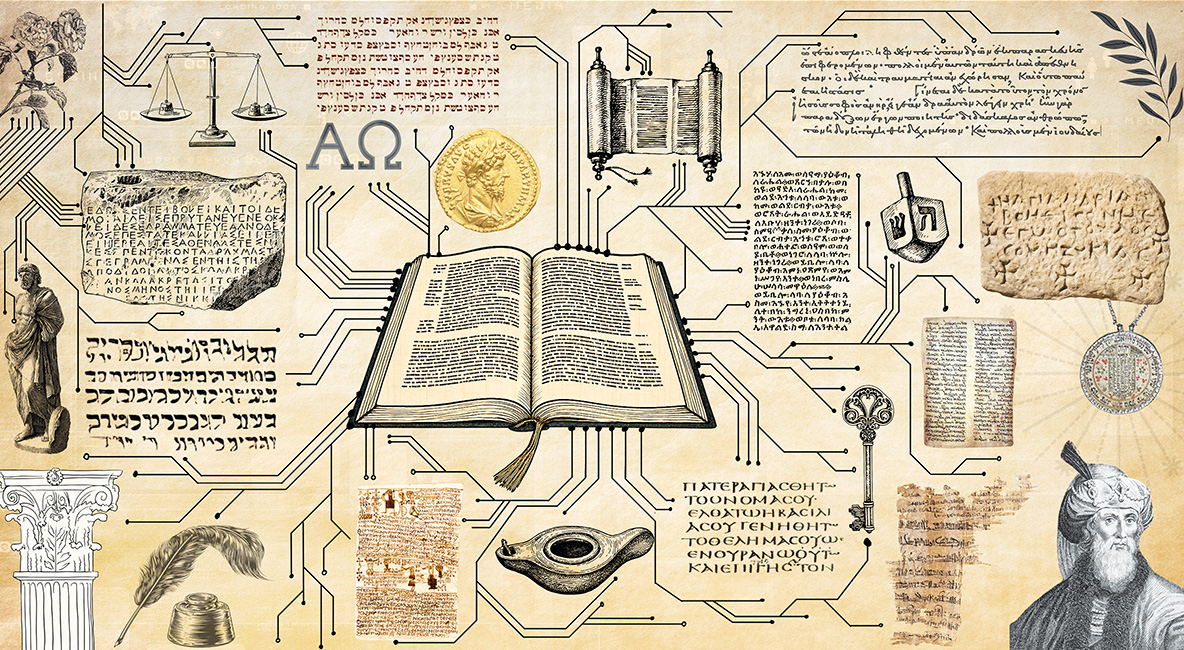
Collage depicting various sources relating to the Corpus Judaeo-Hellenisticum. Collage: Andrej Lacko