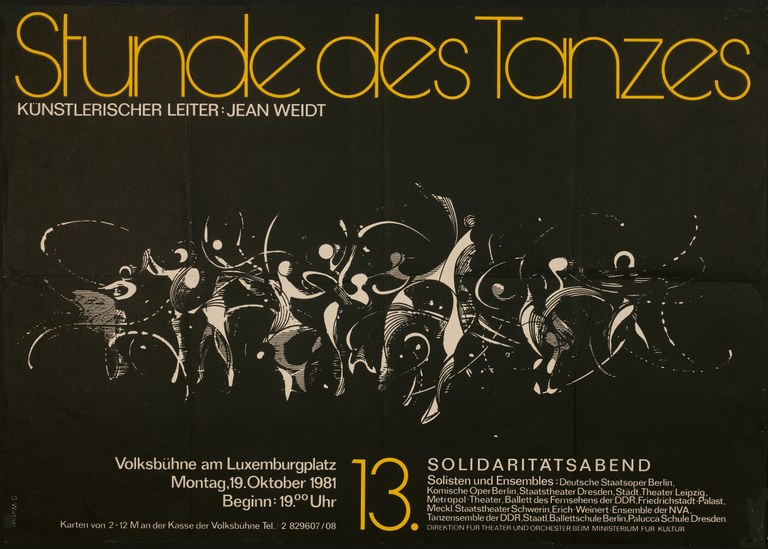
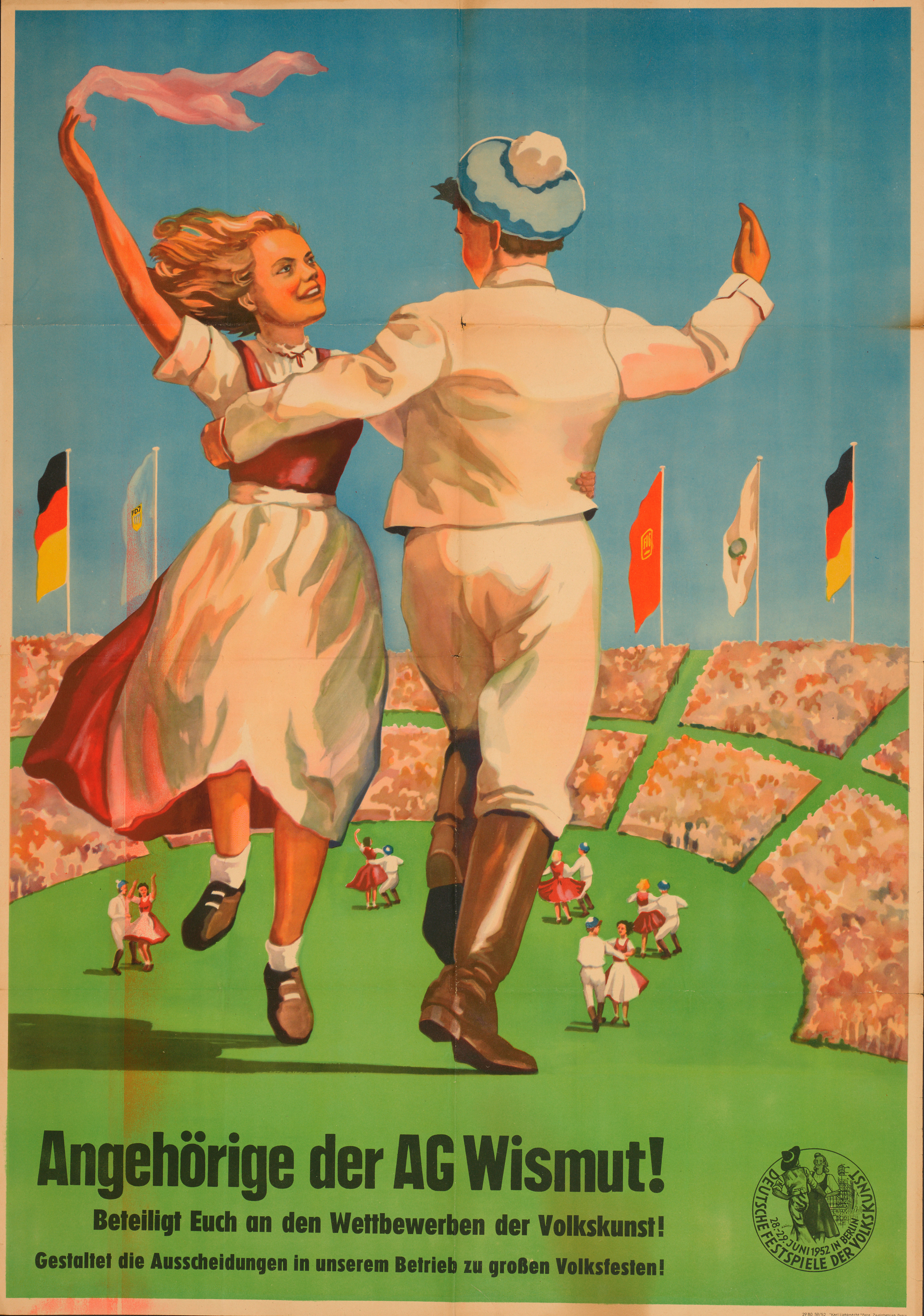
Poster for 'Deutsche Feste der Volkskunst' (German festivals of folk art). It says: 'All members of AG Wismut! Take part in the folk art competitions! Turn the heats in our company into big folk festivals!' Signature: NL 408/897
Documents and a wide range of media objects relating to the dance history of the GDR are primarily preserved in the collections of the Dance Archive Leipzig (formerly the Dance Archive of the GDR), which have already been catalogued on an object level at Leipzig University Library. Building on this foundation, the project examines selected examples to explore how data on individuals, institutions, locations, and events or performances can be interconnected to enhance their usability. These data will be reviewed and contextualized through interviews with contemporary witnesses. This enables personal experiential knowledge to be linked with findings from previous research projects and publications, making it searchable and accessible.
At the Saxon Academy of Sciences and Humanities, existing research software is being further developed to open up new areas of application, particularly for event-related research data.
The project as a whole aims to develop both a scholarly and digital methodology that will benefit future projects as well.
Photographs, films, posters, program booklets, books, journals, and manuscripts document the practice of dance in the GDR in relation to specific events—such as dance festivals, ballet competitions, and individual performances. These materials also reflect how dance and dancing were intended to be shaped and instrumentalized in line with the socialist worldview and concept of humanity.
At the same time, contradictions emerge in the cultural policies of the GDR and in the efforts of cultural institutions to implement these policies in practice. Ideological guidelines and official statements, however, do not necessarily reflect the attitudes and thinking of those involved. Rather, it must be assumed that there was individual distance from official programs even within the realm of dance, as well as interpretive flexibility for the audience.
While research on dance in the GDR has so far been limited to individual studies, there is a clear need to bring together the political and institutional frameworks with individual expressions and manifestations of artistic practice. Responding to this need, the project places a strong focus on conducting oral history interviews.
Experts and practitioners of dance in the GDR are interviewed using qualitative oral history methods, and the resulting conversations are analyzed alongside archival materials. Based on a digital research infrastructure developed at the Saxon Academy of Sciences and Humanities, the project aims to create a suitable data model to capture a wide variety of sources, enrich them with metadata, and improve their accessibility through semantic linking. In doing so, the project also seeks to advance existing data models for event-related research, supporting scholarly analysis and communication of dance as intangible cultural heritage.
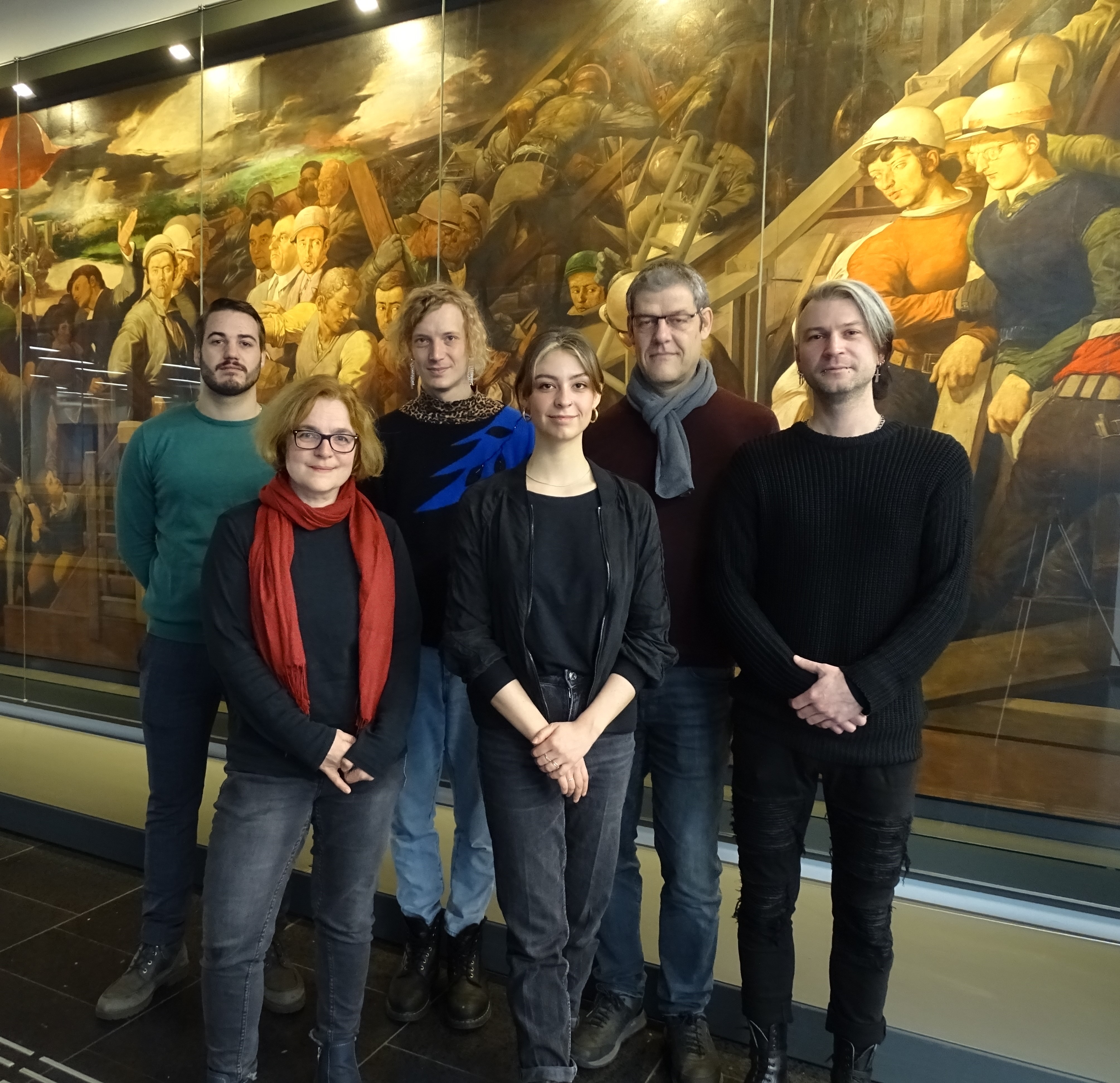
From left: Leopold Mehlhose, Dr. Melanie Gruß, Philipp Sauer, Caroline Helm, Prof. Dr. Patrick Primavesi, Uwe Kretschmer

This project is co-financed by tax revenue based on the budget approved by the Saxon State Parliament.
Project team
Project head
- Prof. Dr. Patrick Primavesi, Universität Leipzig, Institut für Theaterwissenschaft
PD Dr. Franziska Naether, Sächsische Akademie der Wissenschaften zu Leipzig
Project employees (University of Leipzig)
Dr. Melanie Gruß, Universität Leipzig, Institut für Theaterwissenschaft
Caroline Helm, B.A., Universität Leipzig, Institut für Theaterwissenschaft
Project employees (Saxon Academy of Sciences and Humanities)
Philipp Sauer, Sächsische Akademie der Wissenschaften zu Leipzig
Leopold Mehlhose, Sächsische Akademie der Wissenschaften zu Leipzig, lm32puku@studserv.uni-leipzig.de (WHK)
Extended project team:
Prof. Dr. Ralf Stabel (Experte, Interviews)
Uwe Kretschmer, Mag. art.
Project running time:
1. August 2023 – 31. March 2026
Contact details
Original project title
Kulturerbe Tanz in der DDR. Pilotprojekt zur Modellierung von Ereignisdaten unter exemplarischer Berücksichtigung des Erfahrungswissens von Expertinnen und Experten