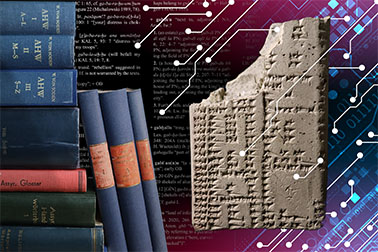
With the Leipzig Akkadian Dictionary, a new dictionary of the most important Ancient Near Eastern language, Babylonian-Assyrian (or Akkadian for short), will be created over a period of 17 years.
Babylonian-Assyrian, usually referred to by its ancient name “Akkadian”, is the most important language of the Ancient Near East. It was spoken and written from the 3rd millennium BCE until the beginning of the Common Era in Mesopotamia, the land surrounding the rivers Euphrates and Tigris, and in neighboring regions of the Near East corresponding to the modern territories of Iraq, Syria, Turkey, Lebanon, Israel, Iran and Egypt. Akkadian belongs to the Semitic language family and is closely related to Arabic, Hebrew and Aramaic, among others. The Akkadian texts written in cuneiform script on clay tablets and stone monuments are extremely numerous, their combined volume exceeding that of ancient Latin writings; Akkadian is therefore one of the best documented languages of the entire ancient world.
Texts of various genres were written in the Akkadian language: Letters went back and forth between kings, officials and private individuals; the administrations of palaces and temples recorded their extensive business on clay tablets; legal transactions were documented in writing; kings enacted laws and boasted of their deeds in lengthy inscriptions; scribes wrote the Gilgamesh epic, the Flood myth and numerous other literary texts; learned physicians, diviners and astrologers compiled medical manuals and long lists of omens.
However, the Akkadian dictionaries still used in Ancient Near Eastern studies today are outdated. Several thousand words that have been discovered in the constant influx of newly published cuneiform texts are not included in them. Words that are already known can now be defined much more precisely and in greater detail on the basis of new evidence. This is where the new Leipzig Akkadian Dictionary comes in: the vocabulary of Akkadian is to be collected in its entirety, reanalyzed and presented in an online dictionary. The Leipzig Akkadian Dictionary is a reference dictionary that not only translates the words into English, German, French and Arabic, but also documents them in their contexts and various usages. The digital publication makes it possible to systematically compile the vocabulary not alphabetically but according to text groups, to link the dictionary with other digital projects and to integrate the older printed dictionaries in digital form.
In this way, a fundamental resource will be created for scholars working on cuneiform texts, but also for numerous neighboring disciplines. The Leipzig Akkadian Dictionary is linked to the Master’s program in Altorientalistik at the University of Leipzig through an annual Masterclass Akkadische Lexikographie.
Contact details
Sächsische Akademie der Wissenschaften zu Leipzig
Leipzig Akkadian Dictionary
c/o Altorientalisches Institut
Goethestraße 2
04109 Leipzig
Tel.: +49 341 9737098
wende@saw-leipzig.de