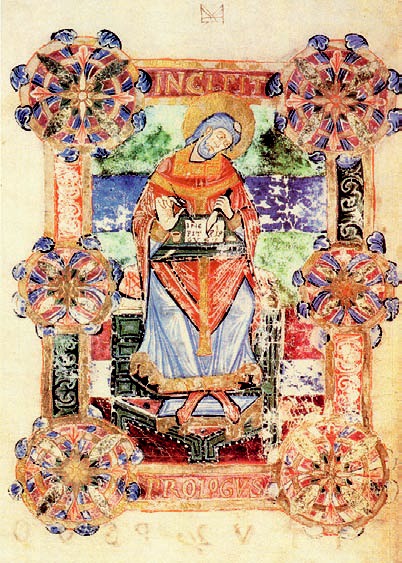
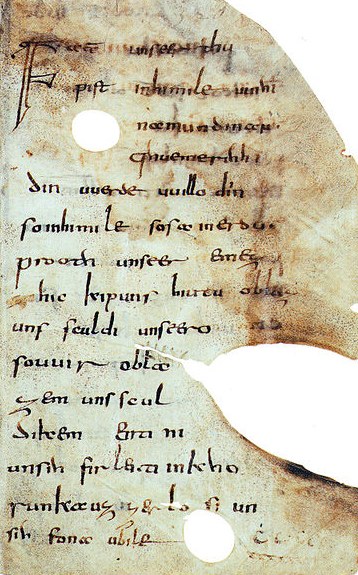
Depiction of Venantius Fortunatus, Bishop of Poitiers in the 6th century writing a hagiography in Latin on a parchment using a quill, an erasing knife and ink. Works written by him were read and annotated in monastery schools, i.e. provided with explanations of words in German. Poitiers, Bibliothèque municipale, ms 250 (136), fol. 21 v, 11th century.
Original project title: Althochdeutsches Wörterbuch
The Old High German Dictionary (Althochdeutsches Wörterbuch) fully describes the vocabulary of the earliest stage of the German language, supported by illustrative citations from corpus material. Designed to be edited in ten volumes, it provides a comprehensive analysis of the entire lexical material preserved in texts, glosses, and glossaries, covering a period of eight centuries from the beginning of written German tradition dating from 8th century records to records from the 13th to the 15th century, provided the latter can be traced back to Old High German (OHG) sources. In terms of regional variety, the OHG Dictionary covers an area from the Alemannic-Bavarian south via various parts of Old Franconia to the Middle Low German and Old Saxon areas. The dictionary’s foundation is the material compiled by Elias von Steinmeyer (1848–1922), whose archive has continuously been supplemented. Currently, it consists of about 750,000 entries excerpted from annotated philological editions.
Along with its precise methodical approach, the complex conception of the OHG Dictionary goes back to the work of Elisabeth Karg-Gasterstädt (1886–1964) and Theodor Frings (1886–1968). It strives for comprehensive in-depth analysis and validity in all matters of language history in order to provide historic lexicography with a fundamental long-term research tool. Attested spellings are collected under a normalized headword. For each of them, phonetic, grammatical, semantic, and syntactic information is given with regard to their specific contexts. All records are analyzed and completely listed. Their contexts are quoted selectively according to their illustrative character or their degree of difficulty in order to illustrate and validate the usage of a word. Systematic references to other dictionaries of Old Germanic languages as well as of more recent stages of the German language demonstrate the regional occurrence as well as the historic development of the words.
The OHG Dictionary provides insights into the German language and culture at their earliest stage.
Both language and culture acquired their distinctive features by adopting antiquity and Christianity as well as by their close relationships to Romanic and Irish-Anglo-Saxon cultures.
Online version of the dictionary
Since 31 March 2017 an online edition of the dictionary is available online. It follows the print edtion at intervals of three years. It is identical to the print edition except for occasional corrections to letters. It can be cited by volume and column number.
Film about the project (YouTube, in German)
https://youtu.be/mDwsv9VJBJE
You may use automatically generated subtitles for English.
Guided Tour
Guided Tour Old High German Dictionary
Further information
Please visit our German project page for more information such as related literature, reviews and news.
Project group
Contact details
Sächsische Akademie der Wissenschaften zu Leipzig
Karl-Tauchnitz-Str. 1
04107 Leipzig
Tel.: +49 341 697642-24
Fax: +49 341 697642-44
huschmid@rz.uni-leipzig.de
bulitta@saw-leipzig.de
Digital resource
Online version of the dictionary: https://awb.saw-leipzig.de/